
Immunosuppressant-Echinacea Interaction Checker
This tool helps you understand if your immunosuppressant medication interacts dangerously with echinacea. Echinacea stimulates the immune system, while immunosuppressants suppress it. Mixing them can cause serious health risks, including organ rejection or disease flare-ups.
People take echinacea to boost their immune system. It’s natural, widely available, and many believe it helps prevent colds or shorten them. But if you’re on immunosuppressant medication-whether after a transplant, for an autoimmune disease, or another serious condition-taking echinacea could be putting your health at serious risk. The problem isn’t just theoretical. Real patients have ended up in the hospital because of this combination. And the reason is simple: echinacea and immunosuppressants work in opposite directions. One tries to wake up your immune system. The other tries to shut it down. When they meet, chaos can follow.
What Echinacea Actually Does to Your Immune System
Echinacea isn’t just one herb. It’s a group of plants, mostly Echinacea purpurea, used for over a century. Native American tribes used it for wounds, infections, and snakebites. In the 1890s, Eli Lilly started selling it as a medicine. Then antibiotics came along, and it faded into the background-until the 1990s, when herbal supplements exploded in popularity.
Today, echinacea is one of the top-selling herbal supplements in the U.S., with $29.5 million in retail sales in 2022 alone. People take it because they think it helps prevent colds. But what does it actually do inside your body?
Research shows echinacea stimulates certain immune cells. It wakes up macrophages, neutrophils, and natural killer cells. These are the body’s first responders. They hunt down viruses and bacteria. Echinacea also increases the movement of white blood cells and boosts the activity of phagocytosis-the process where immune cells eat up invaders. It even activates fibroblasts, which help repair tissue.
All of this sounds great-until you realize that if you’re on immunosuppressants, you don’t want your immune system waking up. You want it quiet.
What Immunosuppressants Are and Why They’re Critical
Immunosuppressants are powerful drugs. They’re prescribed to people who’ve had organ transplants-kidneys, livers, hearts-to stop the body from rejecting the new organ. They’re also used for autoimmune diseases like lupus, rheumatoid arthritis, and multiple sclerosis, where the immune system attacks the body’s own tissues.
Common immunosuppressants include:
- Cyclosporine
- Tacrolimus
- Azathioprine
- Mycophenolate mofetil
- Methotrexate
- Corticosteroids (like prednisone)
These drugs don’t just lower immunity a little. They suppress it deeply. Even a small increase in immune activity can trigger rejection or flare-ups. That’s why transplant patients are told to avoid crowds, wash hands constantly, and skip flu shots without doctor approval.
Now imagine someone takes echinacea on top of this. It’s like turning up the volume on a system that’s been silenced.
The Dangerous Conflict: Stimulate vs. Suppress
This is where the conflict gets real. Echinacea’s short-term effect? Immune stimulation. Long-term use? Some studies suggest it might actually suppress immunity. But here’s the catch: even if long-term use leads to suppression, the initial spike in immune activity is enough to cause trouble.
Doctors don’t need long-term use to see problems. Just a few days of echinacea can be enough. The American Society of Health-System Pharmacists classifies the interaction as “moderate” and says to avoid it entirely. The American Society of Transplantation says transplant patients should avoid echinacea completely. Eighty-seven percent of transplant centers follow this rule.
Why? Because the consequences aren’t theoretical. There are documented cases:
- A 55-year-old man with pemphigus vulgaris-a rare autoimmune skin disease-had a severe flare-up after starting echinacea. He was on immunosuppressants. His doctors had to increase his medication just to get partial control back.
- A 61-year-old man with lung cancer developed life-threatening low platelets (thrombocytopenia) while taking echinacea with chemotherapy drugs.
- A 32-year-old man developed thrombotic thrombocytopenic purpura (TTP), a rare blood disorder, after using echinacea for a cold. He needed emergency treatment.
These aren’t rare anecdotes. They’re published in medical journals. And they’re not isolated.
What the Data Shows: Real Patient Stories
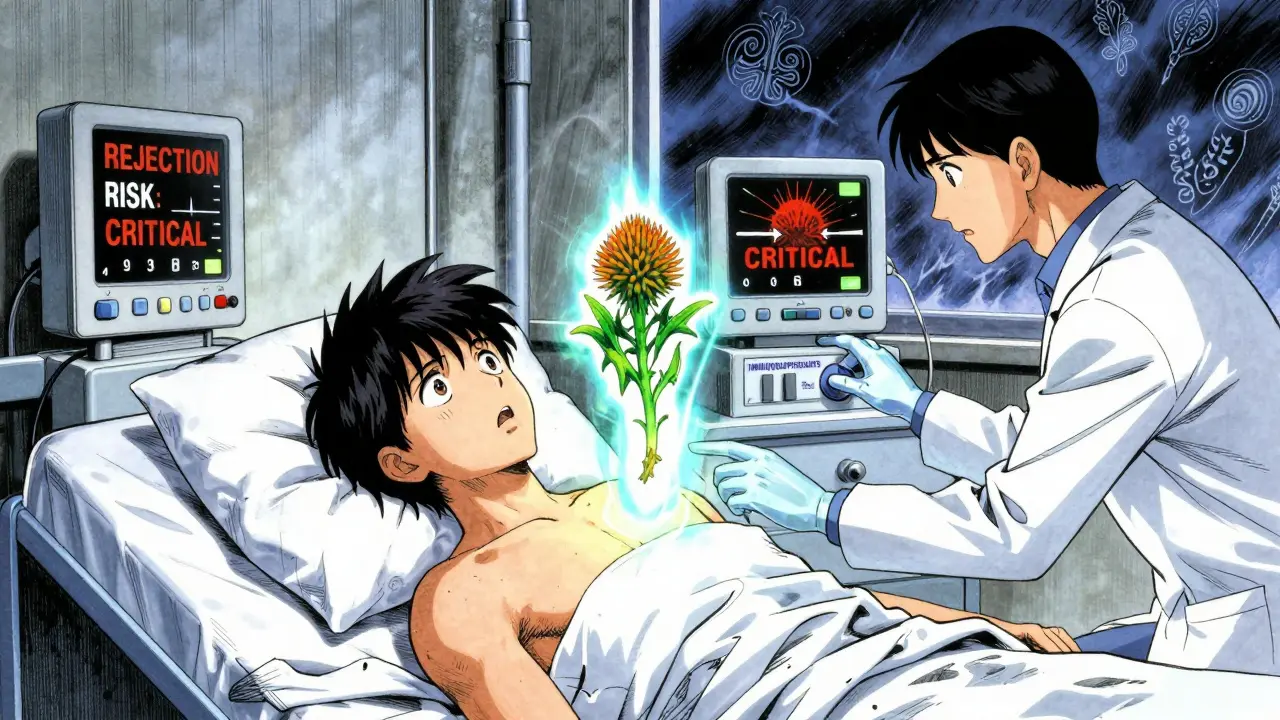
A 2021 survey of 512 transplant recipients found that 34% had taken echinacea after their transplant. Of those, 12% reported complications their doctors believed were linked to herbal supplements. That’s more than 1 in 10.
On patient forums like Inspire and HealthUnlocked, a 2022 analysis of 147 posts found 23 reports of suspected echinacea interactions. Seventeen patients said their immunosuppressant doses had to be increased. Six had acute organ rejection episodes.
None of these were confirmed as caused by echinacea in official medical records. Why? Because most patients don’t tell their doctors they’re taking supplements. They think it’s “just a herb.” But herbs aren’t harmless. Especially when they directly fight your prescription drugs.
The National Center for Complementary and Integrative Health (NCCIH) says this interaction is one of echinacea’s primary safety concerns. The European Medicines Agency says the risk “cannot be excluded.” And the FDA issued warning letters in 2023 to supplement makers for not disclosing these risks on labels.
Why Other Herbs Are Different
Not all herbal supplements behave like echinacea. Milk thistle, for example, affects liver enzymes but doesn’t touch immune cells. Ginger has mild anti-inflammatory effects. Turmeric? It’s mostly about reducing inflammation, not activating immune cells.
Echinacea is unique because it directly targets immune pathways. Its active ingredients-alkamides, polysaccharides, caffeic acid derivatives-bind to receptors on immune cells. One key compound, isobutylamide, even interacts with CB2 receptors, which are part of the body’s endocannabinoid system and play a role in immune regulation.
That’s why echinacea doesn’t just “help your immune system.” It changes how your immune system works. And if you’re on immunosuppressants, that change can be dangerous.
What You Should Do
If you’re taking immunosuppressants, here’s the bottom line:
- Do not take echinacea. Not for colds. Not for “boosting immunity.” Not even for a few days.
- Don’t assume “natural” means safe. Natural doesn’t mean harmless. Many deadly poisons are natural.
- Always tell your doctor about every supplement, vitamin, or herb you take-even if you think it’s “just tea.”
- Ask your pharmacist to check for interactions before starting anything new.
There’s no safe window. No “low dose” that’s okay. The risk isn’t about how much you take. It’s about the mechanism. Echinacea changes immune cell behavior. And that’s enough to undo months of careful treatment.
The American College of Rheumatology says patients on immunosuppressive therapy for autoimmune diseases should avoid echinacea. That’s not a suggestion. That’s a guideline backed by 92% of rheumatologists.
The Bigger Picture
Over half a million Americans are on immunosuppressants after transplants. Millions more take them for autoimmune diseases. The global echinacea market hit $142 million in 2022. Nearly half of users take it for immune support.
That’s a dangerous mix. People aren’t trying to hurt themselves. They’re trying to feel better. But without knowing the risks, they’re walking into a trap.
Right now, the National Institutes of Health is running a $2.4 million study (NCT04851234) to see exactly how echinacea affects tacrolimus levels in kidney transplant patients. Results are expected in 2025. But we don’t need to wait. The evidence we have now is enough to say: don’t take the risk.
Your immune system isn’t something you can tweak like a phone setting. It’s a complex, delicate balance. And echinacea doesn’t just nudge it-it shifts it. When you’re on immunosuppressants, that shift can cost you your transplant. Or your health. Or your life.
Can I take echinacea if I’m on a low dose of immunosuppressants?
No. Even low doses of immunosuppressants are carefully calibrated to keep your immune system just under control. Echinacea can still trigger immune activation, which may be enough to cause rejection or disease flare-ups. There is no safe threshold when these two interact.
What if I only took echinacea for three days?
Even short-term use can be risky. Studies show immune-stimulating effects begin within hours of taking echinacea. For transplant patients or those with autoimmune conditions, even a brief spike in immune activity can trigger rejection or flare-ups. It’s not worth the gamble.
Are all echinacea products the same?
No. Different species (E. purpurea, E. angustifolia, E. pallida) and parts of the plant (roots, leaves, flowers) contain different concentrations of active compounds. But no form is considered safe with immunosuppressants. All types have shown immune-stimulating effects in research.
Is there a safer herbal alternative for immune support?
If you’re on immunosuppressants, the safest approach is to avoid herbal immune boosters entirely. Instead, focus on proven methods: sleep, hydration, stress management, and balanced nutrition. Talk to your doctor about whether vitamin D or zinc might be appropriate-they don’t interfere with immunosuppressants the way echinacea does.
Can I take echinacea after stopping my immunosuppressants?
Never stop immunosuppressants without your doctor’s guidance. Even if you feel fine, stopping can lead to rejection or disease relapse. If your doctor ever says it’s safe to reduce or stop your medication, they’ll tell you. Until then, avoid echinacea completely.



Darren Torpey
March 1, 2026Man, I just read this and my jaw dropped. I’ve been taking echinacea every fall since 2018-‘just to stay healthy’-and my cousin had a kidney transplant last year. I didn’t even think twice. Now I’m sweating bullets. This isn’t some hippie myth-it’s a ticking time bomb in your medicine cabinet.
Why do we assume ‘natural’ equals ‘safe’? Garlic’s natural. Poison ivy’s natural. Neither should be taken lightly. Echinacea isn’t tea. It’s a biological sledgehammer to your immune system. And if you’re on immunosuppressants? You’re basically holding a lit match next to a gas tank and saying ‘I’m fine.’
Thanks for writing this. I’m deleting every echinacea supplement from my shelf today. And I’m telling my whole family. This needs to be shouted from the rooftops.
Lebogang kekana
March 2, 2026Brooooooo. I’m from South Africa and we’ve got a whole culture of herbal remedies-rooibos, devil’s claw, buchu-but even we know when to stop. Echinacea? NO. Not with meds like cyclosporine. You don’t play Russian roulette with your organs.
I lost my uncle to liver rejection. They said he ‘didn’t tell the doctor’ about his ‘immune tea.’ That’s not negligence-it’s ignorance with consequences. This post? It’s a lifeline. Print it. Frame it. Hang it in every pharmacy. Someone’s life depends on this being seen.
Jessica Chaloux
March 2, 2026OMG I’m crying 😭 I’ve been taking echinacea for my ‘chronic fatigue’ and I’m on prednisone for lupus. I had no idea. I thought it was helping me. I just deleted my Amazon cart. I’m calling my rheumatologist right now. Thank you for this. I feel like I almost killed myself without meaning to.
Why isn’t this on the bottle? Why isn’t there a warning label bigger than the product name? 🤬
marjorie arsenault
March 3, 2026You’re not alone. I’ve been helping patients with autoimmune conditions for over 15 years, and echinacea comes up more than you’d think. People think, ‘It’s just a herb,’ but herbs aren’t like aspirin. They’re powerful. And when they hit immunosuppressants? It’s like mixing oil and gasoline in your engine.
The good news? You can still support your immune health-sleep, hydration, stress reduction, vitamin D. Those are safe. Those are real. You don’t need magic potions. Just good habits. And honesty with your care team. Always tell them what you’re taking-even if it’s ‘just tea.’
Deborah Dennis
March 4, 2026This is why I hate holistic medicine. People think they’re smart because they ‘listen to their body’-but their body doesn’t know jack about pharmacokinetics. Echinacea? It’s a scam wrapped in a leaf. And now we have to warn people who don’t even know they’re in danger? The FDA should mandate warning labels on every single herbal supplement. No exceptions. No ‘natural’ loopholes. Just STOP.
Shivam Pawa
March 4, 2026I work in pharma in India. We see this all the time. Patients on tacrolimus take ashwagandha, turmeric, echinacea-all because ‘it’s traditional.’ The problem isn’t the herb. It’s the lack of communication. No one asks. No one tells. The system fails. Research shows 80% of transplant patients don’t disclose supplements. That’s not ignorance. That’s systemic silence. We need better education-not fear.
Diane Croft
March 6, 2026I’m a nurse. I’ve seen three patients in the last year with acute rejection after starting echinacea. All of them swore they ‘only took it for three days.’ Three days is enough. The immune system doesn’t care about your timeline. It reacts. And when it reacts on immunosuppressants? It’s chaos. Please. If you’re on these meds-don’t. Just don’t.
Donna Zurick
March 6, 2026I’m a transplant mom. My son got his heart at 17. We’ve been so careful. But I’ll admit-I bought echinacea last winter because I thought it’d help him ‘stay strong.’ I didn’t know. I thought it was harmless. This post saved us. We’ve thrown it all out. I’m sharing this everywhere. Thank you for speaking up.
Tobias Mösl
March 8, 2026Let’s be real. This isn’t about echinacea. It’s about the supplement industry lying to you. They don’t care if you die. They care if you buy another bottle next month. Look at the labels-no warnings. No FDA oversight. Just ‘natural’ stamped on a bottle like a magic spell.
And the medical system? They’re too busy to ask. ‘Do you take herbs?’ ‘Oh, just ginger.’ And boom-next thing you know, your liver’s rejecting. This is corporate negligence wrapped in organic packaging.
I’m not surprised. Big Pharma hates herbs because they can’t patent them. So they let people die quietly while they sell you $30 bottles of placebo.
tatiana verdesoto
March 10, 2026I’ve been on my meds for 8 years. I used to take echinacea every fall. I didn’t know. I thought it was fine. Then I got a flare-up last year. My doctor looked me dead in the eye and said, ‘Did you take anything new?’ I told him about the tea. He said, ‘That’s it.’ I’ve never felt so stupid. But I’m grateful. I’m sharing this with my support group. No one else should feel this way. You’re not alone. And you’re not crazy. You just didn’t know. Now we do.