
Medication Symptom Checker
Assess Your Medication Symptoms
This tool helps determine if your symptoms are likely side effects, adverse reactions, or unrelated events based on medical criteria.
Your Result
When you start a new medication, you’re often handed a long list of possible side effects. Headache. Nausea. Dizziness. Fatigue. It’s easy to assume every symptom you feel after taking a pill is caused by the drug. But that’s not always true. In fact, mixing up side effects with adverse drug reactions - or worse, just calling everything an "adverse event" - can lead to unnecessary fear, wrong decisions, and even dangerous choices like stopping life-saving medicine. The truth? These terms aren’t interchangeable. They mean very different things in medicine, and knowing the difference could protect your health.
What Exactly Is a Side Effect?
A side effect is a known, predictable, and dose-related consequence of how a drug works in your body. It’s not a mistake. It’s not an accident. It’s built into the drug’s chemistry. Think of it like this: if a drug is designed to lower blood pressure, it might also make you feel dizzy because it’s slowing down your heart rate too much. That dizziness? That’s a side effect. It’s not random. It’s tied directly to the drug’s intended action. These are the effects that show up in clinical trials. Researchers compare people taking the drug against those taking a placebo. If more people in the drug group get nausea, and it happens often enough to be statistically significant, then nausea becomes a documented side effect. The FDA requires this data to be listed on drug labels. Common examples include:- Constipation from opioids
- Dry mouth from antihistamines
- Stomach upset from NSAIDs like ibuprofen
- Weight gain from certain antidepressants
What Is an Adverse Drug Reaction?
An adverse drug reaction (ADR) is a broader category. It includes side effects - but also things that are unpredictable, rare, and sometimes life-threatening. The World Health Organization defines it as "a response to a drug which is noxious and unintended and which occurs at doses normally used in man." There are two main types of ADRs:- Type A: These are the predictable ones - the side effects we just talked about. They make up 80-85% of all ADRs. They’re dose-dependent. Take more, get worse. For example, taking too much acetaminophen causes liver damage. That’s a Type A ADR.
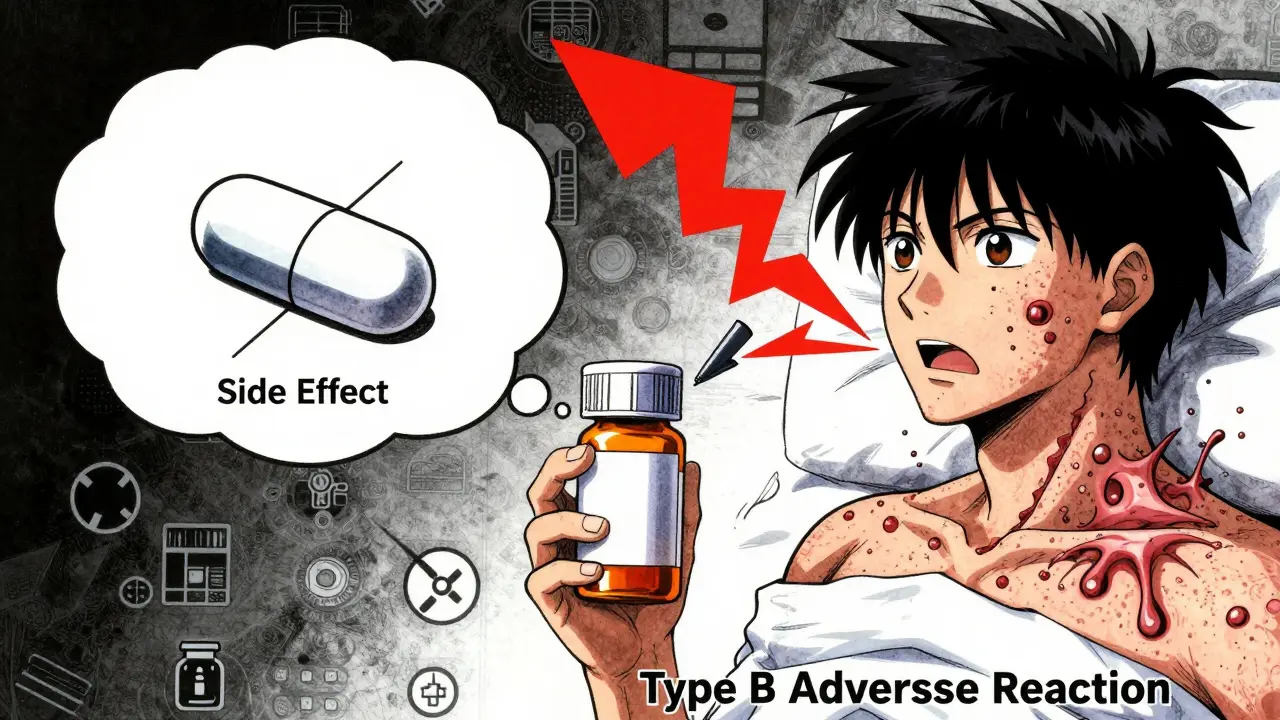
- Type B: These are the surprises. They’re not related to the drug’s main action. They’re often allergic or immune-based. They can happen at any dose. Think of a rash from penicillin, or anaphylaxis from a bee sting - but with medicine. These are rare, maybe 1 in 10,000 people. But they can be deadly.
What’s an Adverse Event? (And Why It’s Not the Same)
An adverse event is any negative health occurrence that happens after you take a drug - whether it’s related to the drug or not. That’s it. No proof needed. No science required. If you take a blood pressure pill and then get a migraine the next day? That’s an adverse event. But is it caused by the pill? Maybe. Maybe not. Maybe you were stressed. Maybe you skipped sleep. Maybe you drank too much coffee. Without more data, you can’t say for sure. In clinical trials, researchers record every single adverse event. Then they analyze: did it happen more often in the drug group than the placebo group? If yes, it becomes a side effect. If no? It’s just a coincidence. A 2020 JAMA study on the blood thinner apixaban found that 12.3% of people on the drug got headaches - but so did 11.8% of people on the placebo. So headache? Not a side effect. Just an adverse event. This matters because patients often think every bad feeling after taking medicine is the drug’s fault. That’s not true. And believing it can lead to dangerous outcomes.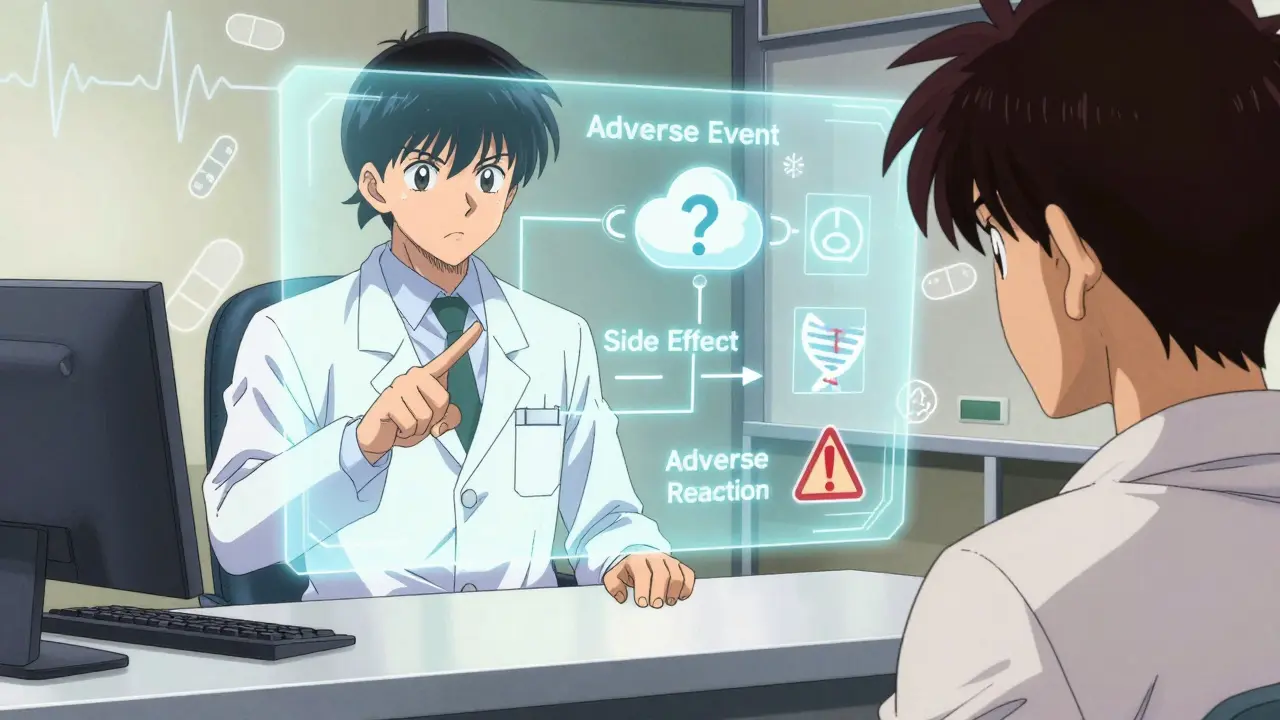
Why This Confusion Costs Lives
The Institute for Safe Medication Practices found that 68% of healthcare workers use "side effect" and "adverse reaction" interchangeably in notes. That’s a problem. But it’s even worse for patients. A 2021 study showed 43% of people stopped taking life-saving medications because they thought a random headache or fatigue was a "side effect" - when it was just an adverse event. They didn’t realize the symptom might have been caused by stress, illness, or something else entirely. So they quit their statin, their blood thinner, their thyroid pill - and put themselves at risk. The FDA requires drug companies to report all adverse events. But only those confirmed as caused by the drug become adverse reactions. In 2023, the FDA received 1.2 million adverse event reports. Only 32.3% of those were later confirmed as true adverse reactions. That means nearly two-thirds of the reports were just coincidences. Doctors are trained to document "adverse reaction" only when causality is clear. If they write "side effect" for something unproven, it can trigger insurance denials, mislead future providers, or even get a drug pulled from the market based on bad data. In 2018, the diabetes drug canagliflozin was temporarily withdrawn in Europe because transient side effects were mislabeled as serious reactions. The drug was later reinstated after better analysis.How to Tell the Difference in Real Life
You don’t need a medical degree to spot the difference. Here’s a simple 3-step check:- Timing: Did the symptom start right after you began the drug? Or did it show up weeks later? Side effects usually appear early. Other issues might come later.
- History: Have you had this symptom before - without the drug? If yes, it’s probably not the medication.
- Pattern: Does it match known side effects listed on the label? If it’s something totally new - like a rash, swelling, or trouble breathing - stop the drug and call your doctor immediately. That’s likely a Type B reaction.

What You Should Do
When you get a new prescription:- Ask: "Which of these are side effects? Which are rare reactions?"
- Don’t assume every new symptom is the drug’s fault.
- Keep a simple log: what you took, when, and what happened.
- If something serious happens - chest pain, swelling, trouble breathing - stop the drug and get help right away.
- If it’s mild and vague - fatigue, mild nausea - wait a few days. See if it fades. Talk to your pharmacist before quitting.
The Bigger Picture
The line between side effects and adverse reactions isn’t just academic. It’s a safety tool. When patients and providers use the right terms, decisions get better. Risks get clearer. Medications stay in use when they should. Harm gets caught early when it matters. New technology is helping. AI tools now analyze real-world data from electronic health records to spot true side effects faster. The FDA’s new rules require these tools to distinguish between events and reactions by the end of 2025. Pharmacogenomics - testing your genes to see how you’ll react to drugs - is making it possible to predict who’s at risk for certain side effects before they even start. But none of that matters if you don’t understand the basics. Side effects are expected. Adverse reactions are confirmed. Adverse events? Just red flags that need more checking. Knowing the difference isn’t about jargon. It’s about taking control. It’s about not letting fear drive your health choices. And it’s about making sure you get the full benefit of medicine - without giving up on it because of a headache that had nothing to do with the pill.Are side effects the same as allergic reactions?
No. Side effects are predictable and tied to how the drug works in your body - like drowsiness from antihistamines. Allergic reactions are immune responses - like hives, swelling, or anaphylaxis - and are unpredictable. They can happen even with a tiny dose. Allergic reactions are a type of adverse drug reaction (Type B), but not all side effects are allergic.
Can a side effect become dangerous over time?
Yes. Some side effects are mild at first but can build up. For example, long-term use of NSAIDs can cause stomach ulcers or kidney damage. Even if you only had mild nausea at first, ongoing use without monitoring can lead to serious harm. Always talk to your doctor if a side effect gets worse or lasts longer than expected.
Why do drug labels list so many side effects?
Drug labels list every symptom that occurred more often in clinical trial participants taking the drug than those on placebo - even if it happened in just 1% of people. That doesn’t mean you’ll get it. It just means it was observed. Most people experience none or only one or two. The list is there for safety, not to scare you.
If I feel worse after starting a new medication, should I stop it?
Don’t stop without talking to your doctor. Some side effects - like nausea or fatigue - fade after a few days. Stopping abruptly can be dangerous, especially with blood pressure, antidepressant, or seizure meds. Call your provider. They can help you tell if it’s a side effect, an adverse event, or something else entirely.
Can I report an adverse event even if I’m not sure it’s caused by the drug?
Yes. That’s exactly what the FDA’s MedWatch system is for. If something unusual happens after taking a drug, report it - even if you’re unsure. Your report helps regulators spot patterns. Thousands of reports led to the discovery of serious side effects with drugs like Vioxx and certain birth control pills. You don’t need proof. Just observation.



Aayush Khandelwal
January 1, 2026Man, this breakdown is *chef's kiss*. Side effects are the drug’s ‘signature move’-like how SSRIs make you feel like a zombie for two weeks until your brain recalibrates. But an ADR? That’s the drug pulling a Houdini and turning into a venomous snake you didn’t sign up for. I’ve seen patients quit metformin because of ‘side effects’-only to find out they had a viral stomach bug. The terminology isn’t jargon-it’s armor.
Sandeep Mishra
January 1, 2026Love this. Really. 🙏
It’s not just about medical accuracy-it’s about trust. When we blur the lines between ‘side effect’ and ‘adverse event,’ we make people afraid of their own healing. I’ve had elderly patients cry because they thought their ‘fatigue’ meant the drug was ‘poisoning’ them. It’s not poison. It’s a tool. And tools can be loud before they work. Patience, context, and a good pharmacist save lives.
Joseph Corry
January 3, 2026Let’s be real-this entire article is a beautifully wrapped placebo for the medically anxious. You’re treating ‘side effects’ like sacred texts when they’re just statistical noise from underpowered trials. The FDA’s 32% confirmation rate? That’s not a feature, it’s a failure of pharmacovigilance. And ‘adverse event’ as a catch-all? That’s not nuance-that’s intellectual laziness dressed up as clinical rigor. You’re giving people permission to ignore symptoms by labeling them ‘unconfirmed.’ That’s dangerous.
Colin L
January 5, 2026Okay, but have you considered that the entire framework of ‘side effect’ vs ‘adverse reaction’ is a capitalist construct designed to protect Big Pharma from liability? The WHO definition sounds noble, sure, but in practice, it’s a legal loophole. If a drug causes depression in 1 in 10,000 people, and that person kills themselves-was it the drug? Or their pre-existing trauma? The system doesn’t want to know. It wants to classify, document, and move on. Meanwhile, real people are left gasping in the fog of terminology. I’ve seen patients get dropped from care because their ‘adverse event’ wasn’t ‘confirmed’ enough. That’s not science. That’s bureaucracy with a stethoscope.
Hayley Ash
January 6, 2026lol so if i get a headache after taking tylenol its just stress but if i get one after some new pill its a side effect? sure janet
kelly tracy
January 7, 2026Stop gaslighting patients. You call a headache an ‘adverse event’ like it’s some minor glitch. But what if it’s the first sign of a stroke? Or a brain bleed? You’re telling people to wait and see when they should be screaming for help. This isn’t ‘nuance’-it’s negligence wrapped in a PowerPoint. And don’t even get me started on pharmacists being ‘your best resource.’ Most of them are just reading off a screen while scanning your prescription. You think they remember what 27 different drugs do? Wake up.
Nadia Spira
January 9, 2026Let’s be honest-this entire taxonomy is a linguistic shell game. ‘Side effect’ sounds benign. ‘Adverse reaction’ sounds terrifying. ‘Adverse event’ sounds bureaucratic. But the reality? Drugs are complex, biological grenades. The body doesn’t care about your labels. If you’re on 7 meds and feel like you’re melting, it doesn’t matter if it’s ‘confirmed’ or not-you’re suffering. And the system doesn’t fix suffering. It files it. That’s not medicine. That’s paperwork with a white coat.
henry mateo
January 10, 2026thx for this post. i was freakin out cause i got a rash after starting my new blood pressure med and thought i was gonna die. turned out it was just a side effect and went away in 3 days. i didnt know the difference between side effect and adverese event. now i feel less scared. also i think pharmacists are underappreciated. they saved my life without even knowing it.