
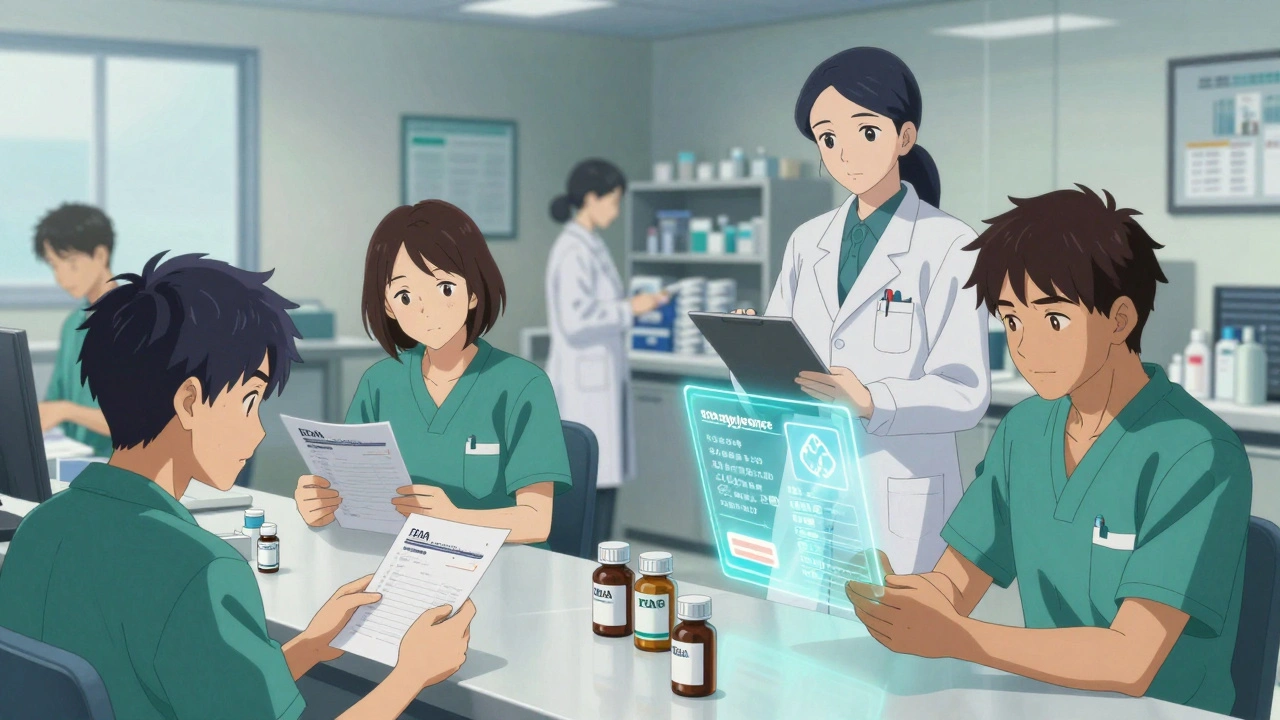
Why Generic Drugs Are Now the Standard in Workers’ Compensation
When a worker gets hurt on the job, the goal is simple: get them back on their feet as quickly and safely as possible. But behind every treatment plan is a stack of prescriptions-and the cost of those prescriptions is eating into workers’ compensation budgets faster than ever. That’s why generic substitution has become the backbone of modern occupational health management. It’s not a trend. It’s policy. And in 2025, it’s the law in most states.
Generic drugs aren’t cheaper because they’re worse. They’re cheaper because they don’t carry the marketing, patent, and R&D costs of brand-name drugs. The FDA requires them to have the same active ingredients, strength, dosage form, and absorption rate as their brand-name counterparts. In plain terms: they work the same. But they cost about 80% less. A $100 brand-name painkiller? The generic version? Around $20.
How Generic Substitution Works in Workers’ Comp
It’s not as simple as swapping a pill at the pharmacy. The system is built on rules, formularies, and legal mandates. Every state has its own rules, but the pattern is clear: if a generic version exists, it’s the default unless a doctor writes a clear medical reason not to use it.
For example, Tennessee’s 2023 Workers’ Compensation Medical Fee Schedule says outright: “An injured employee should receive only generic drugs or single-source patented drugs for which there is no generic equivalent unless the authorized treating physician documents medical necessity for the brand-name product.” That’s not a suggestion. It’s a requirement. The doctor must explain why the brand is needed-not just because the worker prefers it, but because of a documented clinical issue like an allergy, absorption problem, or prior failure with the generic.
Pharmacy Benefit Managers (PBMs) like OptumRx, Express Scripts, and Prime Therapeutics handle the actual substitution. They run formularies that list approved drugs and automatically flag brand-name prescriptions for review. If a doctor tries to prescribe Celebrex (brand) when generic celecoxib is available, the pharmacy won’t fill it without prior authorization. That’s not bureaucracy-it’s cost control.
The Numbers Don’t Lie: Generic Use Is Rising Fast
Since 2015, generic drug use in workers’ compensation has jumped from 84.5% to an estimated 89.2% in 2023. In states with strong formularies like California, it’s hit 92.7%. Colorado just passed a rule requiring 95% generic use for drugs on its formulary, effective January 2024. That’s not a target. That’s the new baseline.
Why? Because brand-name drug prices kept climbing. From 2014 to 2019, list prices for common brand-name drugs used in workers’ comp rose by 65.5%. Meanwhile, generic prices dropped by 35%. That’s not a coincidence. It’s market logic. When a brand-name drug’s patent expires, multiple generic manufacturers enter the market. Competition drives prices down. But here’s the twist: sometimes, even generics stop getting cheaper.
The Hidden Problem: When Generics Stop Saving Money
For years, generics were the obvious win. But in 2022, reports from Enlyte and others started pointing to a new issue: consolidation in the generic drug manufacturing space. A handful of companies now control most of the market. When one shuts down production-due to FDA violations, supply chain issues, or profit decisions-it can cause shortages. And when supply drops, prices spike.
Take the case of a generic muscle relaxant used in back injuries. In 2020, it cost $12 per 30-count bottle. By 2023, it was $48. Why? Because two of the three manufacturers stopped making it. The remaining one raised prices. This isn’t rare. It’s happening with over 150 generic drugs nationwide. The system was built on the assumption that generics would always be cheaper. That’s no longer guaranteed.
Doctors and Workers Still Have Misconceptions
Even with all the data, old beliefs die hard. A 2021 survey by the American College of Occupational and Environmental Medicine found that 73% of occupational health providers say patient skepticism about generics is their biggest challenge. Workers often think, “If it’s cheaper, it must be weaker.”
It’s not true. The FDA tests generics rigorously. They must match the brand-name drug in bioequivalence-meaning they enter the bloodstream at the same rate and to the same extent. In fact, a 2019 survey found that 82% of injured workers who tried generics reported the same level of pain relief as with the brand-name version.
Still, many doctors hesitate. Some prescribe brand names out of habit. Others fear a patient will complain. But in states with strict substitution laws, that’s no longer an option. Providers who don’t adapt end up spending hours on prior authorizations, phone calls, and paperwork just to get a brand-name drug approved.
What About Special Cases? When Generics Aren’t Enough
There are exceptions. Not every drug can be swapped. Drugs with a narrow therapeutic index-like warfarin, levothyroxine, or certain seizure medications-require extra caution. A tiny difference in absorption can cause harm. For these, doctors must document why the brand is necessary, and sometimes, the system allows it.
Another gray area: biologics. These are complex drugs made from living cells, like those used for severe arthritis or nerve pain. Until recently, there were no generic versions. Now, biosimilars are entering the market. Texas started allowing them in workers’ comp in 2022. They’re not exact copies, but they’re close enough to be considered interchangeable under FDA rules. Expect this to grow. By 2025, more than 20 biologic drugs used in workers’ comp will have biosimilar alternatives.
How to Navigate the System as an Injured Worker
If you’re injured and prescribed a medication, here’s what to expect:
- You’ll be given a generic unless your doctor says otherwise.
- If you’re given a brand-name drug, ask why. Is it because there’s no generic? Or because your doctor believes it’s better for you?
- If you’re skeptical, ask for the FDA’s bioequivalence data. You can find it online-no doctor visit needed.
- If you’ve had a bad reaction to a generic before, document it. That’s valid medical justification for a brand.
- Don’t assume a higher price means better results. The science says otherwise.
Many workers worry switching to a generic will mean less relief. But the data shows otherwise. In fact, studies show that when workers are properly educated about generics, their satisfaction with treatment goes up-not down.
The Future: More Automation, Less Guesswork
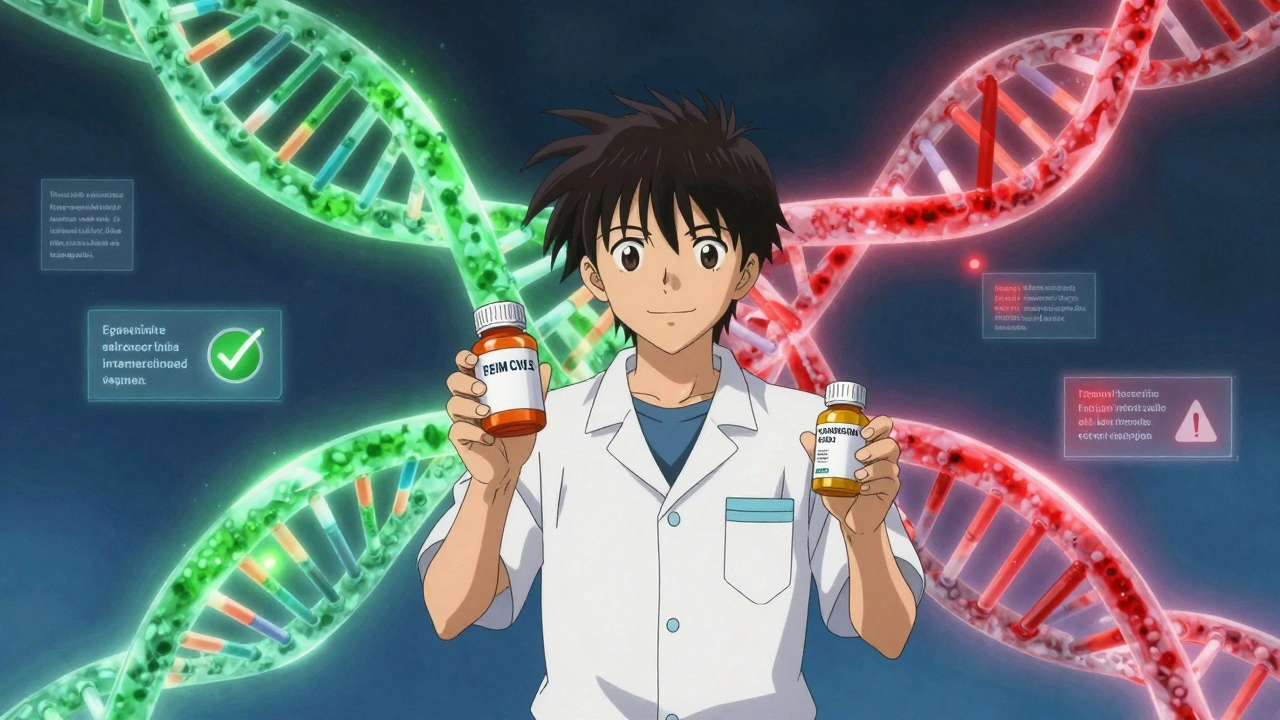
By 2025, the goal is to get generic substitution to 93.5% of all eligible prescriptions. That’s not just about saving money. It’s about making the system more predictable. The next big shift? Pharmacogenomics. This is testing a worker’s DNA to see how they metabolize certain drugs. It’s still early, but it could mean: “This generic works for 90% of people. But for you, it won’t. Here’s why.”
Right now, we’re still using a one-size-fits-all approach. In the future, substitution won’t just be about cost. It’ll be about personalization. But for now, the rule is simple: if a generic exists, use it. Unless there’s a real medical reason not to.
What States Are Doing Right
States with formal drug formularies-38 as of 2023-are seeing the best results. California, Tennessee, Colorado, and Florida all have clear rules, automated systems, and provider education programs. They don’t just rely on pharmacies to enforce substitution. They train doctors. They educate workers. They track outcomes.
States without formularies? They’re lagging. Their generic use hovers around 83%, meaning they’re still leaving money on the table-and potentially delaying care because of cost disputes.
Bottom line: if you’re managing workers’ comp claims, generic substitution isn’t optional. It’s the standard. And if you’re an injured worker, it’s your right to get the same care at a fraction of the cost.



Kay Jolie
December 5, 2025Let’s be real-generic substitution isn’t just cost control, it’s a paradigm shift in occupational pharmacoeconomics. The FDA’s bioequivalence thresholds? Barely scratching the surface of therapeutic equivalence. We’re talking about Cmax, AUC, inter-individual variability-metrics that even some prescribers don’t comprehend. And don’t get me started on the PBM formularies; they’re algorithmic black boxes with zero clinical nuance. This isn’t healthcare. It’s actuarial theater dressed in white coats.
Meanwhile, the 89.2% adoption rate? That’s not progress. That’s commodification of pain management. When a muscle relaxant spikes from $12 to $48 because two manufacturers vanished, who’s accountable? Not the PBM. Not the state regulator. Definitely not the worker who’s now stuck with a $48 bottle of placebo with a generic label.
pallavi khushwani
December 7, 2025i think this is actually kind of beautiful in a weird way. like, we’re finally starting to treat medicine like science instead of a luxury brand. generics aren’t ‘cheap’-they’re efficient. the fact that they work just as well? that’s the system working right. sure, sometimes prices go up because of monopolies-but that’s not the fault of generics. it’s the fault of capitalism being lazy. we need more competition, not less. maybe if we forced more factories to make these drugs, prices would stay low. just a thought :)
Dan Cole
December 7, 2025You’re all missing the point. The FDA doesn’t require generics to be therapeutically equivalent-they require them to be bioequivalent. Big difference. Bioequivalence means the drug enters your bloodstream at a similar rate. It says NOTHING about clinical outcomes. Not one peer-reviewed study proves that a generic NSAID produces the same analgesic effect across 95% of the population. And yet, we’re mandating substitution based on pharmacokinetic proxies? That’s not medicine. That’s statistical gambling with human pain.
And don’t cite that 2019 survey. It’s funded by the Generic Pharmaceutical Association. Conflict of interest? Check. Methodology? Flawed. Sample size? Inadequate. This isn’t science. It’s corporate propaganda masquerading as policy.
Billy Schimmel
December 9, 2025So let me get this straight-you’re telling me I can’t get my $100 brand painkiller because it’s ‘too expensive,’ but if I break my back, I’m supposed to be fine with a $20 pill that might as well be sugar? Yeah, I’m sure that’ll make me feel better. 🙃
Shayne Smith
December 10, 2025my cousin works in workers’ comp adjuster land and she says the real drama isn’t the generics-it’s the doctors who still write brand names just to avoid the 3-hour phone call with the PBM. like, why are we making healthcare so hard? if the generic works, just use it. if it doesn’t, then fight the system. but don’t make the worker the middleman in a bureaucratic ping-pong match.
Katie O'Connell
December 10, 2025It is imperative to underscore that the current regulatory framework governing generic substitution in the context of workers’ compensation constitutes a structural misalignment between fiscal imperatives and clinical autonomy. The imposition of formulary mandates, while ostensibly economically rational, constitutes a de facto erosion of the physician-patient therapeutic alliance. Furthermore, the absence of longitudinal pharmacovigilance data on substituted agents renders the entire paradigm epistemologically precarious. One cannot, in good conscience, advocate for systemic standardization absent robust, patient-centered outcome metrics.
Clare Fox
December 12, 2025honestly i think the real issue is nobody talks to workers about this. like, you get a script, you see it’s a different pill, you panic. no one says ‘hey this is the same stuff, just cheaper’-so people assume it’s junk. maybe if they just handed out a one-pager with the FDA bioequivalence charts? people would chill. also-why are we still using paper forms in 2025? 🤦♀️
Akash Takyar
December 13, 2025It is truly commendable that the industry has made significant strides toward cost efficiency and equitable access to essential medications. However, we must remain vigilant against the unintended consequences of systemic consolidation in the generic manufacturing sector. The emergence of monopolistic pricing patterns, particularly in drugs with narrow therapeutic indices, demands a proactive, multi-stakeholder approach: regulatory oversight, supply chain diversification, and transparent pricing disclosures. Let us not sacrifice patient safety on the altar of fiscal prudence.
Arjun Deva
December 13, 2025GENERIC SUBSTITUTION IS A GOVERNMENT PLOT TO CONTROL THE WORKERS. THE FDA? OWNED BY PHARMA. THE PBMs? OWNED BY INSURANCE. THEY WANT YOU TO TAKE THE SAME DRUGS SO THEY CAN TRACK YOU, MONITOR YOU, AND EVENTUALLY STOP PAYING FOR TREATMENT ALTOGETHER. DID YOU KNOW THAT THE SAME COMPANIES THAT MAKE GENERIC PAINKILLERS ALSO MAKE THE ALGORITHMS THAT DECIDE WHAT YOU GET? THEY’RE USING YOUR INJURY DATA TO TRAIN AI TO DENY FUTURE CLAIMS. THIS ISN’T HEALTHCARE. IT’S SOCIAL ENGINEERING.