
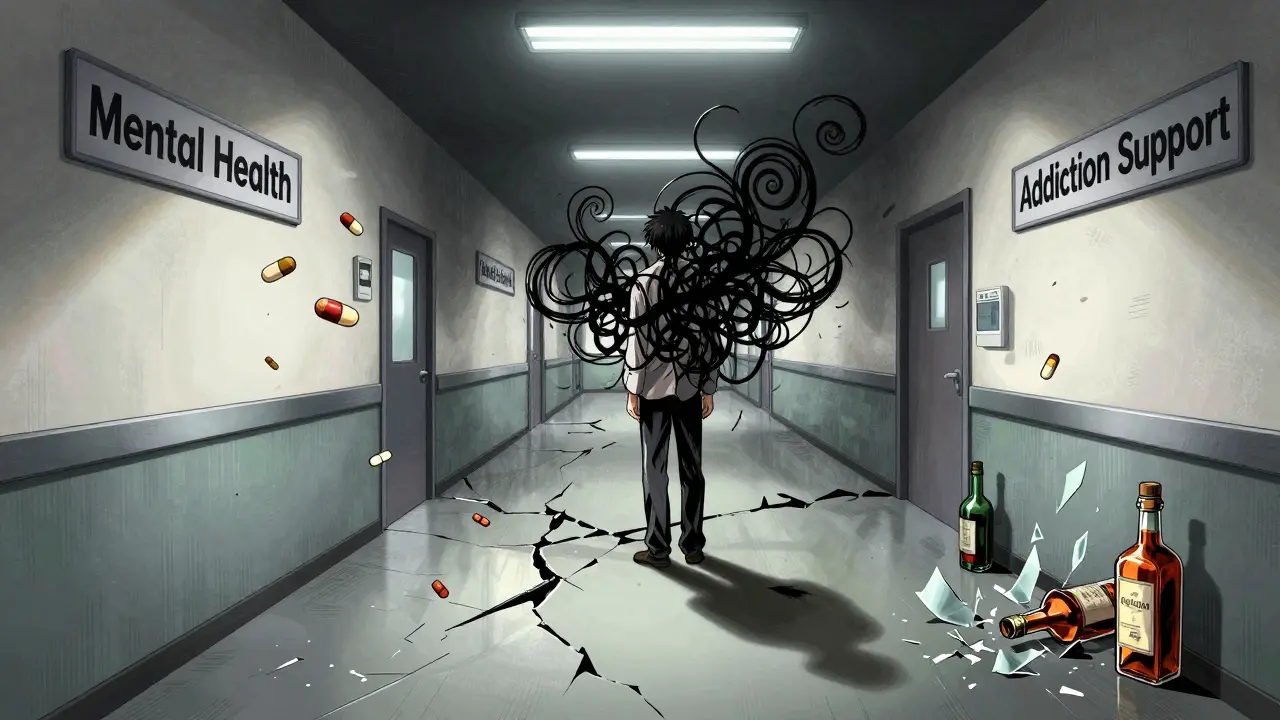
Imagine needing help for anxiety and also struggling to stop drinking. You go to a mental health clinic, and they tell you to see a different office for addiction support. Then you go there, and they say your anxiety needs to be handled first. You’re stuck jumping between two systems that don’t talk to each other. This isn’t rare-it’s the norm. And it’s failing millions of people.
Why Separate Treatment Doesn’t Work
For decades, mental health and substance use treatment ran on parallel tracks. One provider handled depression or schizophrenia. Another handled alcohol or opioid use. The idea was simple: fix one thing at a time. But in reality, it didn’t work. People with both conditions often got worse. Their anxiety made them drink more. Their drinking made their psychosis harder to control. The system wasn’t broken because of bad intentions-it was broken because it didn’t understand how these illnesses connect.Research shows that about 20.4 million U.S. adults live with both a mental illness and a substance use disorder. That’s one in five people seeking help for either issue. Yet only 6% of them get care that addresses both at the same time. The rest are sent back and forth between clinics, losing momentum, feeling confused, or giving up entirely.
Traditional models don’t just waste time-they waste lives. When someone with bipolar disorder stops taking their meds because they’re using stimulants, their mood crashes. When someone with PTSD turns to alcohol to numb flashbacks, the drinking makes the trauma symptoms worse. It’s a cycle. And treating just one part of it is like trying to fix a car by only replacing the tires while the engine is on fire.
What Is Integrated Dual Diagnosis Care?
Integrated Dual Diagnosis Treatment, or IDDT, is the answer. It’s not a new idea-it’s been around since the 1990s-but it’s still underused. Developed at Dartmouth and refined over decades, IDDT means one team, one plan, one path. The same therapist, case manager, or psychiatrist treats both the mental illness and the substance use. No handoffs. No confusion. No blame.This isn’t just about convenience. It’s about science. Studies show IDDT reduces the number of days people use alcohol or drugs. It doesn’t always fix everything overnight-mood symptoms or motivation might not improve right away-but it cuts down on the core problem: using substances to cope with mental pain.
The model works because it’s built on three simple truths:
- Mental illness and addiction are not separate problems-they’re deeply linked.
- People need help now, not after they’ve ‘gotten clean’ or ‘stabilized’.
- Recovery doesn’t mean abstinence right away-it means reducing harm and building a better life.
IDDT doesn’t demand sobriety as a precondition. That’s a game-changer. Many people aren’t ready to quit. But they might be ready to cut back, avoid using before appointments, or stop mixing alcohol with their antidepressants. IDDT meets them where they are.
The Nine Core Pieces of IDDT
IDDT isn’t a vague philosophy-it’s a structured approach with nine proven components:- Motivational interviewing: A conversation style that helps people explore their own reasons for change, without pressure or judgment.
- Substance abuse counseling: Focused on triggers, cravings, and real-world strategies-not just lectures about quitting.
- Group treatment: Safe spaces where people with similar struggles share experiences and support each other.
- Family psychoeducation: Teaching loved ones how to respond without enabling or blaming.
- Self-help group participation: Encouraging involvement in groups like Alcoholics Anonymous or SMART Recovery, but not requiring it.
- Pharmacological treatment: Using medication for depression, schizophrenia, or addiction (like methadone or naltrexone) when appropriate.
- Health promotion: Helping people eat better, sleep more, exercise, and manage physical health issues often ignored in mental health care.
- Secondary interventions: For those who aren’t responding-more intensive support, case management, or housing help.
- Relapse prevention: Planning for setbacks, not pretending they won’t happen.
Each piece is designed to work together. For example, if someone with schizophrenia starts using cocaine, the team doesn’t just push them into rehab. They ask: Is their medication working? Are they hearing voices more often? Are they homeless? Are they using to quiet their thoughts? Then they adjust the whole plan-not just the drug part.

What Makes IDDT Different From Other Approaches?
There are three main ways IDDT breaks from the old model:- One team, not two: The same person handles your therapy, your meds, and your substance use goals. No more explaining your story twice.
- One plan, not two: Your treatment plan doesn’t have a ‘mental health section’ and a ‘substance use section.’ It’s one document: ‘How I’m going to feel better and stay safe.’
- One message: Instead of hearing ‘You need to quit drinking’ from one provider and ‘Your anxiety is getting worse’ from another, you hear: ‘We’re going to help you reduce your drinking so your mood stabilizes, and we’ll adjust your meds if needed.’
This isn’t just kinder-it’s more effective. People who get IDDT are less likely to end up in the ER, jail, or homeless shelters. They’re more likely to keep appointments, stay on their meds, and find stable housing. And they report feeling less alone.
Why Isn’t Everyone Getting This Care?
The problem isn’t that IDDT doesn’t work. It’s that it’s hard to set up.First, staff need training. A three-day workshop isn’t enough. Clinicians must learn how to treat schizophrenia and opioid use disorder at the same time. That takes time, supervision, and ongoing support. Many clinics just don’t have the budget for it.
Second, funding is broken. Most insurance systems still pay for mental health visits and addiction treatment as separate services. If a clinic wants to offer IDDT, they have to bill twice, track two sets of records, and fight two sets of rules. It’s expensive and confusing.
Third, there’s stigma. Some providers still believe people with addiction aren’t ‘ready’ for mental health care. Others think people with psychosis can’t handle substance use counseling. These myths are false-but they’re still common.
The numbers tell the story: 20.4 million people need integrated care. Only 6% get it. That’s a gap of 15.5 million people. In Australia, the situation isn’t much better. Even in Melbourne, where mental health services are relatively strong, IDDT programs are rare outside public hospitals and specialized NGOs.

What Does Success Look Like?
Success isn’t always sobriety. Sometimes, it’s:- Going from drinking 10 drinks a night to 2, and sleeping through the night for the first time in years.
- Staying on lithium because you’re no longer using cocaine to ‘feel normal.’
- Getting a job because you stopped using every weekend and started showing up for therapy.
- Reconnecting with your kids because you stopped using in front of them.
A 2018 study tracked 154 people with severe mental illness and addiction. After IDDT, they used alcohol and drugs on fewer days. Not everyone stopped completely. But their lives improved. They had fewer hospital visits. They felt more in control.
That’s the point. Recovery isn’t about perfection. It’s about progress. IDDT doesn’t promise a cure. It promises a path-one that respects how complicated real life is.
The Future of Dual Diagnosis Care
Change is coming, but slowly. Medicaid and Medicare in the U.S. are starting to pay for integrated care models. States like Washington have done cost-benefit analyses showing IDDT reduces emergency room use and incarceration-even if the upfront cost is high.Technology is helping too. Telehealth lets people in rural areas connect with specialists who know how to treat both conditions. Apps now track mood and substance use together, giving clinicians real-time data.
The biggest barrier now isn’t evidence. It’s willpower. Health systems need to decide: do they want to treat people as whole human beings-or as two separate problems?
If you or someone you know is struggling with both mental illness and substance use, ask for IDDT. Ask if the clinic has a team that handles both. If they don’t, push for it. Demand better. Because no one should have to choose between healing their mind and healing their body.
What is the difference between dual diagnosis and co-occurring disorders?
They mean the same thing. "Dual diagnosis" is the older term, often used in clinical settings. "Co-occurring disorders" is more modern and preferred because it avoids the implication that there are only two problems. It’s a spectrum-one person might have depression, PTSD, and alcohol use disorder. The key is that all conditions are treated together, not one after another.
Can you get IDDT if you’re not ready to quit drinking or using drugs?
Yes. IDDT is built on harm reduction, not forced abstinence. The goal isn’t to make you quit immediately-it’s to help you reduce harm, stay safe, and build a life where using less becomes possible. Many people start by cutting back on weekends, avoiding drugs before therapy, or switching from heroin to methadone. Progress, not perfection, is the standard.
Is IDDT covered by insurance?
Sometimes. In the U.S., Medicaid and some private insurers are starting to cover integrated care, but it’s inconsistent. Many clinics still bill mental health and substance use services separately, which makes reimbursement harder. If you’re in Australia, Medicare doesn’t yet fully fund IDDT programs, but some private health insurers and state-funded mental health services do. Always ask the provider how they handle billing.
How long does IDDT treatment last?
There’s no fixed timeline. IDDT is often long-term, especially for people with serious mental illnesses like schizophrenia or bipolar disorder. Some people get intensive support for 6-12 months, then transition to less frequent check-ins. Others stay in contact for years. The goal isn’t to "finish" treatment-it’s to build skills and support that last a lifetime.
What if my therapist doesn’t know how to treat both conditions?
You’re not alone. Many providers haven’t been trained in IDDT. If your therapist only treats mental health or only addiction, ask if they can refer you to a team that does both. If not, contact your local mental health service or a national helpline like SAMHSA’s National Helpline (1-800-662-HELP) for a referral. You deserve care that addresses your whole life-not just half of it.

Candice Hartley
January 26, 2026This is exactly what I needed to hear. I’ve been stuck in that loop for years. 🙏
suhail ahmed
January 28, 2026Man, this hits different in India too. We got zero integration here. Mental health? Still whispered about. Addiction? Treated like a moral failure. No one connects the dots. I’ve seen cousins rot in separate clinics while their trauma screamed louder each day. We need this model bad.
Andrew Clausen
January 29, 2026The term 'dual diagnosis' is outdated and clinically imprecise. 'Co-occurring disorders' is the accurate, evidence-based terminology. The article uses both interchangeably, which undermines its credibility. Precision matters in medical communication.
Anjula Jyala
January 31, 2026IDDT is just another buzzword pushed by pharma-funded think tanks. The real issue is the collapse of public mental health infrastructure. You don't need integrated programs you need funding. And you need to stop pathologizing coping mechanisms. People drink because life is unbearable not because they have a disorder
Harry Henderson
February 1, 2026STOP WASTING TIME WITH THEORY. I’ve been in 3 rehabs and 5 therapists. None of them talked to each other. I got a 12-step pamphlet from one and an SSRI script from another. My anxiety got worse. My drinking got worse. This isn’t rocket science. One team. One plan. One damn human being trying to survive. Do it now. Not next year. NOW.
April Williams
February 1, 2026I used to be one of those people who thought addicts just needed to get their act together. Until my sister died overdosing while on a waiting list for therapy. They told her to wait until she was 'stable'. She never got stable. Now I scream at every clinic I walk into. Stop making people earn care. They’re already suffering. Just help them.
Kirstin Santiago
February 2, 2026I work in a community clinic and we tried piloting IDDT last year. Staff were overwhelmed at first. But after 6 months? ER visits dropped 40%. People started showing up. One guy went from using daily to using only on weekends-and he got his GED. That’s not magic. That’s just someone finally being seen.
Kathy McDaniel
February 3, 2026i read this at 3am after my third glass of wine and honestly? i cried. i didnt even know i was waiting for someone to say it was okay to not be fixed yet. thank you.
Conor Flannelly
February 5, 2026In Ireland, we’re starting to see glimmers. The HSE has a few pilot sites in Cork and Galway. But funding is still siloed. You need a psychiatrist, a social worker, a peer support specialist, and a case manager-all trained in trauma-informed, harm-reduction approaches. That’s not cheap. But it’s cheaper than prisons and ERs. We just need the political will.
Marian Gilan
February 6, 2026You think this is about care? Nah. It’s about control. The system doesn’t want you healed. It wants you compliant. IDDT? Just a fancier leash. They’ll still monitor your urine, track your meds, and label you 'noncompliant' if you slip. They don’t want to fix the system. They want to fix you so you stop being a burden.
Desaundrea Morton-Pusey
February 7, 2026This is why America’s broken. We treat people like broken machines. You got anxiety? Here’s a pill. You got a drinking problem? Go to AA. We don’t care that your dad beat you and you’ve never had a real meal since you were 12. Just fix the parts. Keep the machine running.
Conor Murphy
February 8, 2026I’m a peer support specialist in Dublin. I’ve been sober 7 years. I also have bipolar. My team didn’t care which was 'first'. They just asked: 'What’s hurting you today?' That’s all I needed. No shame. No hierarchy. Just someone who gets it.
Murphy Game
February 10, 2026The real conspiracy? They don’t want you well. If everyone got integrated care, the whole mental health industrial complex would collapse. Pharma, clinics, insurance-everyone profits from the chaos. IDDT sounds nice. But it’s not profitable. So it stays rare. Wake up.
astrid cook
February 11, 2026I don’t know why people keep romanticizing this. You can’t treat addiction without hitting rock bottom. That’s how recovery works. You need to lose everything before you’re ready. This 'meet them where they are' stuff just enables. If you’re not ready to quit, you don’t deserve help.